
Shade Sail Guide for Houston Homeowners (2026)
Oct 29, 2026
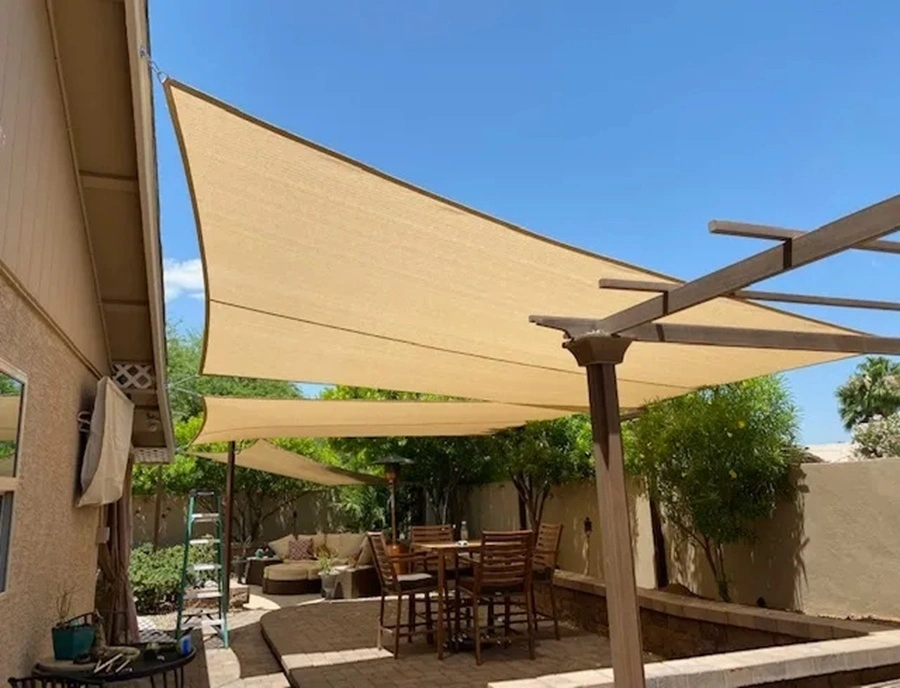
By July, a Houston backyard can feel like an oven with a patio set in it. The deck is too hot for bare feet, the pool water has turned into bathwater, and the whole family retreats indoors until October. A shade sail fixes that problem faster, and usually for less money, than almost any other permanent shade option. It’s a piece of tensioned fabric, anchored to posts or your house, that blocks the sun overhead while the breeze keeps moving right through it.
But a good shade sail is not a patio umbrella with better marketing. It’s a small engineered structure, and the choices you make about fabric, posts, layout and timing decide whether it works hard for 15 years or sags, flaps and gives up in its first hurricane season.
This guide covers what Houston homeowners actually need to know: how much sun and heat a sail really blocks, which fabric belongs on the Gulf Coast, why posts drive the price, what a realistic budget looks like, how sails compare with pergolas, and how to plan for storms, permits and HOAs. By the end, you’ll know exactly what to ask for when you request a quote.
Key Takeaways
- A shade sail (also called a sun sail) is a tensioned fabric canopy that blocks UV and radiant heat while letting air flow through.
- Houston’s normal summer high sits near 95 degrees and summers keep getting warmer, so shade is one of the few fixes that goes after the heat source.
- Breathable HDPE fabric is the best fit for Gulf Coast wind, and heavier commercial-grade fabric holds its shape longer.
- Posts and footings, not fabric, drive most of the cost of a professional shade sail; most Houston residential sails run $4,000 to $8,000 per sail installed.
- A sail is usually cheaper and faster than a pergola, but it isn’t a roof; choose a solid cover if you need full rain protection.
- Plan for hurricane season (June 1 to November 30) by knowing how and when your sail comes down.
- Check city rules and your HOA before you build, and get a written quote with warranty terms.
What Is a Shade Sail, and Why Do Houston Homes Need One?
A shade sail is a piece of knitted fabric stretched tight between three or more anchor points. Those anchors are usually steel posts, a strong fascia or wall, or a mix of both. Triangles, squares and rectangles are the most common shapes, and larger yards often layer two or three sails to cover awkward footprints and shed rain more easily. The name comes from the engineering: like a ship’s sail, the fabric holds its shape because it is under tension, not because something rigid is holding it up.
Shade Sail vs. Sun Sail: Is There a Difference?
No. “Sun sail” and “shade sail” are two names for the same product, and installers use them interchangeably, as Pathstone Co’s FAQ explains. If you’ve searched for either one, or for a “sun shade sail,” you’ve been looking at the same thing: a tensioned fabric canopy that shades a patio, deck, pool, play area or driveway. You’ll see both terms throughout this guide.
Why Houston’s Heat Is a Different Problem
Houston doesn’t just get hot. It stays hot. The normal summer high holds near 95 degrees and the normal low near 75, according to Space City Weather. A typical year brings roughly half a dozen 100-degree days, although the record is 46, set in 2011. The trend is moving the wrong way, too: a Climate Central analysis, reported by Axios, found that Houston’s average summer temperature climbed 5.6 degrees between 1970 and 2022.
Humidity makes it worse. Gulf moisture keeps nights warm, so your patio never gets a chance to cool down and your pool never gets a chance to recover. Here’s the perspective most guides skip: in Houston, shade is the only cooling tool that attacks the source of the heat. A misting fan or ceiling fan moves hot air around. A sail stops the sun from loading heat into your deck, your brick, your cushions and your pool in the first place. That’s why a well-placed sail can make the difference between a yard you walk through and a yard you live in.
For homeowners, the most common uses are shade sails for patios and decks (the “sail shade patio” setup most people picture), backyard dining areas, play areas for kids and pets, driveways, and pools. You can see how each one is typically handled on our residential shade sails page, and we cover the pool-specific details later in this guide.
How Much Sun and Heat Does a Shade Sail Actually Block?
“Blocks UV” is on every product page, but the details matter, especially if you have kids who live in the yard from May through September.
UV Protection: What the Numbers Mean
The CDC says UV rays can start damaging unprotected skin in as little as 15 minutes, and it lists seeking shade as one of its core recommendations (CDC). Commercial-grade knitted fabrics like Gale Pacific’s Commercial 95, which Pathstone installs, are marketed with a UV block of roughly 96 percent, according to the manufacturer’s sample card. Put simply, only about 4 percent of the UV that hits the fabric gets through to the space below.
That’s excellent, but it isn’t the whole story. The Skin Cancer Foundation points out that not all shade is equally protective. Fabric quality matters, but so do the size of the structure, how close it is to other shade, and whether it has side protection. UV also bounces off reflective surfaces like water and light-colored concrete, so a pool deck gets more indirect exposure than a grassy yard.
The practical takeaway: a shade sail is your best first line of defense, not your only one. Sunscreen, hats and common sense still belong under the sail, and a larger sail that overhangs your seating area generally protects better than one that just barely covers it.
Cooler Air and Cooler Pool Water
Heat reduction is where homeowners notice the difference first. An industry magazine reports that Gale Pacific’s knitted shade structures can reduce temperatures by as much as 35 percent (GBD Magazine). Treat that as a best-case manufacturer figure rather than a promise, because results depend on your layout, sun angle and surfaces. The logic is simple, though: shaded decking, pavers, chairs and cushions stop soaking up direct sun, so they stay cooler to the touch.
Pools respond the same way. When direct sun stops hitting the water for most of the afternoon, it doesn’t heat up as quickly. That’s the exact problem that started Pathstone Co. The founders’ own pool had become a bathtub every July, and a sail over it made the water more comfortable and the deck more usable. You can read the full story on the pool shade sails page.
One honest caveat: shade can’t fix humidity. What it does is remove the radiant heat that makes humid air feel unbearable.
Choosing Shade Sail Fabric: Why HDPE Wins on the Gulf Coast
Fabric is the part of a sail you can see, but it’s also the part that decides how the sail behaves in wind, rain and sun. For residential projects, the answer is almost always the same: UV-stabilized high-density polyethylene, or HDPE.
Breathable vs. Waterproof Fabric
HDPE outdoor shade cloth is knitted, which means it has tiny openings. Air can flow through it, so hot air escapes upward instead of getting trapped under the canopy. It’s also why breathable sails tend to behave better in wind. A solid, waterproof sail catches wind and passes that force down to the anchors, while a breathable sail lets the wind pass through the mesh.
The trade-off is rain. A knitted sail sheds some water and lets the rest drip through, so it is not a roof. Overlapping two or three sails helps channel rain away, and Pathstone Co’s own guidance is straightforward: if you need full rain protection, a solid patio cover is the better choice. In Houston, where afternoon downpours are common, it helps to decide up front whether you want shade, a roof, or both.
Fabric Weight (GSM) Explained
Fabric weight is measured in grams per square meter, or GSM, and heavier fabric generally resists tearing and holds its shape longer. Gale Pacific’s Commercial 95 is a 340 GSM knitted HDPE (the number is right in the product name, and it’s listed in the manufacturer’s specification sheet), which is heavier than the lightweight cloth in many budget kits. That extra material is part of why commercial-grade sails cost more, and part of why they hold their shape longer.
Color, Sun Angle and Your House
Commercial 95 has been offered in more than 20 colors (GBD Magazine), so you can match your home’s trim or contrast it on purpose. Here’s a tip most buyers miss: choose your color and your sun angle at the same time. Think about when you’ll actually use the space, and how that changes over the year. A spot that is gloriously shaded in July can feel like a dark cave in January. Stand in your yard at the hours you really use it, then have your installer plan the sail around those hours.
Every sail we install uses Gale Pacific Commercial 95, so fabric quality is consistent from quote to quote. Our shade sails overview shows the shapes and layouts available.
Posts, Footings and Hardware: Where Your Money Really Goes
Most people assume the fabric is the expensive part of a shade sail. It usually isn’t. The posts and footings are, and understanding why will save you from the cheapest quote that turns into the most expensive mistake.
Why Tension Makes Posts the Main Event
A sail only works when it’s pulled tight, and that tension doesn’t disappear. It travels from the fabric through the hardware and into each anchor point, all day, every day, and spikes when wind picks up. A post that leans even a little will let the sail go slack, and a slack sail flaps, pools water and wears out early.
That’s why Pathstone Co’s posts are square steel with a quarter-inch wall: 4×4 posts for sails up to 23 feet, and 6×6 posts for anything larger. Each one goes 5 to 6 feet into the ground in a concrete footing, and stands 10 to 12 feet above grade. That height gives you comfortable headroom and lets the sail slope so rain runs off. You can see the full breakdown on our shade sail cost guide.
Attaching to Your House vs. Free-Standing Posts
If your home has a strong fascia or wall in the right spot, anchoring one or more corners to it can reduce the number of posts and lower the total. But “strong” is the key word. A roof edge that looks solid may not be built to carry sail loads, which is why a site visit matters more than a photo. Hanging a sail from a weak structure is one of the most common ways a good fabric fails.
Hardware That Survives Humidity
Houston’s humidity eats cheap hardware. Marine-grade stainless steel is the right choice for D-rings, turnbuckles and cables because it resists corrosion. A well-designed sail also uses curved edges and height variation so it can be tensioned into a stable shape, rather than being pulled flat, which is what helps it hold up in wind.
When you compare quotes, ask what size and wall thickness the posts are, how deep the footings go, and what the hardware is made of. If a contractor can’t answer, that’s your answer.
How Much Does a Shade Sail Cost in Houston?
The honest answer is “it depends,” but the range is narrower than most pages make it sound. Most residential shade sails we install around Houston cost $4,000 to $8,000 per sail, fully installed, including design, materials and professional installation. Here’s how that compares to what you’ll see elsewhere.
DIY Kits vs. Professionally Installed Custom Sails
Browse online and you’ll find kits from about $30 to a few hundred dollars, and that’s before posts, hardware or labor. National cost ranges you’ll see online are wide because they mix DIY installs with professional ones.
So why is a custom Houston install higher? Because a kit is just fabric. A Pathstone install includes commercial-grade fabric, marine-grade hardware, engineered steel posts set in concrete, professional tensioning and cleanup. The difference is a structure designed to stand up to Gulf Coast wind, not a canopy you hope survives the summer.
What Changes the Price
- Size and number of sails. Larger spaces often use two or three overlapping sails, and pricing is per sail.
- Posts vs. house anchoring. Posts are the biggest single cost driver.
- Post height and sail size. Sails longer than 23 feet need 6×6 posts.
- Site conditions. Roots, buried utilities, pool equipment, slopes and hard ground can add footing work. A good installer looks for all of this during the consultation, so the written quote is the price you actually pay rather than a number that grows after the first shovel hits the ground.
A Smarter Way to Think About the Price
Here’s a perspective you won’t find on most cost pages. Divide the price by the years you’ll use it. If a $6,000 sail serves for the full length of its 15-year fabric warranty, that works out to about $400 a year, roughly $33 a month, for a yard you can actually use all summer. Compare that with the cost of a pool that’s too hot to swim in, or furniture that fades and cracks in the sun. A written quote before any work starts, which every Pathstone estimate includes, lets you do that math honestly.
Shade Sail vs. Pergola vs. Patio Cover vs. Umbrella
Choosing a shade solution is really choosing a trade-off between cost, permanence, rain protection and approval hassle. Here’s how the common options stack up for a Houston backyard.
| Option | Typical cost | Rain protection | Wind/storm behavior | Approvals |
|---|---|---|---|---|
| Shade sail | $4,000–$8,000 per installed sail (custom) | Partial; breathable fabric | Breeze passes through; can be taken down before storms | Usually lighter; check city and HOA |
| Pergola with shade cloth | Usually more than a sail | Limited | Permanent structure | More likely to need permit and HOA review |
| Louvered pergola / solid cover | Usually the highest cost of the four | Strong | Permanent structure | Most likely to need permit and HOA review |
| Large umbrella | Low | Minimal | Not safe left up in wind | None |
Where Sails Win
Pathstone Co’s view is that a sail is usually the lowest-cost way to put real shade over a patio or pool. It goes up faster than a built structure, comes in custom shapes, lets air move through, and can be taken down ahead of a major storm. For irregular spaces such as a pool with a curved deck, a pair of overlapping sails often covers the area better than a rectangular pergola ever could.
Where Sails Lose
A shade sail is not a roof. If you want to grill during a thunderstorm or keep cushions dry without moving them, a solid patio cover is the right tool, and we’ll say so during your consultation. Many Houston homeowners end up with a hybrid answer: a solid cover over the outdoor kitchen, and a sail over the pool or play area where breeze and affordability matter more.
A Quick Way to Decide
Ask yourself three questions. Do you need to stay dry, or just stay cool? Do you want the structure to be permanent, or able to come down before a storm? And how much approval paperwork are you willing to take on? If the honest answers are “just cool,” “flexible” and “as little as possible,” a sail is almost certainly your best fit. If you answered “dry,” “permanent” and “I don’t mind the process,” price out a solid cover alongside it, and let the written quotes settle the debate.
If you’re weighing these options for a home with an HOA, start with the approval question, because it can eliminate choices before cost ever comes up. Pergolas and solid covers are more likely to trigger both HOA review and a building permit than a sail.
Wind, Hurricanes and Permits: Planning for Houston Reality
A shade sail in Houston has to be planned for weather in a way a sail in San Diego never would.
Building for Wind and Planning for Hurricane Season
Hurricane season runs from June 1 to November 30, and the National Weather Service in Houston/Galveston notes that the peak threat for the Texas coast is August through September, although hurricanes have struck the coast in every month of the season (NWS Houston/Galveston 2026 Hurricane Guide). That timeline overlaps almost exactly with your heaviest sail-use months.
A properly engineered sail, with commercial fabric, stainless hardware and deep concrete footings, is built to handle typical Texas weather. For a named storm, though, many customers simply take the sail down for a few days as a precaution. That’s a smart habit to build in from day one. Before installation, ask your installer how the sail comes down and goes back up, who will do it, and how long it takes. Add “sail down” to your hurricane checklist next to the patio furniture, and you’ll protect both the fabric and the posts. It also helps to photograph the finished install and keep your written quote and warranty paperwork somewhere easy to find, since you’ll want them if a storm ever tests the structure.
Permits, Codes and HOAs
Rules vary by city and by the size and type of structure. Houston is the largest U.S. city without traditional zoning, but building permits are still required for many structures. The City of Houston’s residential permit training materials list exemptions, such as one-story detached accessory structures up to 120 square feet, so a sail’s size, height and anchoring all matter. Surrounding cities, from Katy to Pearland, have their own rules.
Two other facts are worth knowing. First, shade sail installation is not a state-licensed trade in Texas, so no company can honestly claim to be “licensed” for it. What you can ask for is proof of insurance, a written quote, and a clear warranty. Second, your HOA often has the final say regardless of city rules, so get its approval in writing before you sign anything.
We’ll tell you what we expect to apply to your property during the site visit. If you’re unsure where to start, our FAQ covers the most common questions.
From First Call to Finished Install: What to Expect
Knowing the process makes it easier to compare contractors and to avoid surprises. Here’s how a Pathstone Co project works, from the first phone call to the final walkthrough.
The Four Steps
- Free consultation. You tell us about your space and what you’re hoping to fix: too much heat, a pool that’s too warm, a play area that’s unusable.
- Design and measure. We visit, take exact measurements, check sun angles and anchor points, and design the sail.
- Order your materials. Your custom sail is made in the color and size you chose.
- Professional installation. Our team installs the posts, hardware and sail, tensions everything, cleans up and walks you through the finished project.
Most projects take about four weeks from first call to finished install. You can read more on our process page.
How to Get the Most Out of the Site Visit
Treat the consultation like a design session. Walk the yard with us at the time of day you most want shade. Point out where you sit, where the kids play and where the pool is. Mention the neighbors’ trees, the direction your windows face and any HOA rules. The best sails are designed around how you live, not just where the posts are easiest to dig.
If you’re shading a pool, tell us whether you care more about cooler water, a shaded deck or both. Pool layouts often work best with two or three layered sails rather than one large one. If you run a business or an HOA common area instead, our commercial and playground pages cover those projects.
Caring for Your Sail
Quality commercial fabric is low-maintenance, but “low” isn’t “none.” Rinse off dust and pollen occasionally, look over the hardware after major storms, and keep tree limbs trimmed back from the fabric and posts. If you take the sail down for hurricane season, store it dry and loosely folded. Those small habits help you get the full life out of a sail that’s backed by a 15-year fabric warranty and a one-year warranty on the steel posts.
We serve Houston, Katy, Sugar Land, Cypress, The Woodlands, Pearland and the surrounding communities. See the full service area list.
Ready to Cool Down Your Backyard?
A shade sail is one of the simplest ways to take back your yard from the Houston sun, but only when it’s designed, anchored and installed for Gulf Coast conditions. The fabric matters, the posts matter even more, and the planning you do before the first hole is dug (sun angles, anchor points, permits, HOA approval and your storm-day routine) decides whether you love the result for 15 years or regret it in one season.
The good news is that the process doesn’t have to be complicated. Start with an honest consultation, insist on a written quote that spells out the fabric, post size, footing depth, hardware and warranty, and ask how the sail comes down before a storm. Compare quotes on those details, not just the bottom line.
At Pathstone Co, we’re a family-owned Houston company that started because we needed a shade sail for our own pool. We handle everything from the first phone call to the final walkthrough, and we’ll tell you honestly whether a sail is the right fit for your space, or whether a solid cover would serve you better. Book your free, no-pressure consultation at pathstoneco.com/contact or call (713) 489-5141, and let’s get you back outside.
Frequently Asked Questions About Shade Sails in Houston
How much does a shade sail cost in Houston?
Most residential shade sails we install in the Houston area cost $4,000 to $8,000 per sail, fully installed. Size, number of posts, post height and site conditions decide where you land in that range. See our shade sail cost guide for the breakdown.
What’s the difference between a sun sail and a shade sail?
There isn’t one. Both terms describe the same tensioned fabric canopy, and installers use them interchangeably.
Why do people use shade sails?
Mostly for cooler, safer outdoor space at a lower cost than a built structure. A shade sail blocks UV and radiant heat, adds a backyard sun shade without a full roof, lets air flow through, and can be taken down before a storm.
How do you install a shade sail without posts?
You anchor the corners to something strong that already exists, such as a structural wall or a properly built fascia. The catch is that a tensioned sail pulls hard, so the anchor has to be able to carry that load, and a weak roof edge is a common failure point. We check the structure during the site visit and tell you honestly if posts are the safer choice.
How do you hang or put up a shade sail?
Installation means setting anchor points, attaching stainless hardware and tensioning the fabric until it’s taut. Because the loads are significant, we set steel posts in concrete footings and tension each sail professionally. Our process page walks through the four steps.
Can a shade sail handle Houston wind and storms?
A professionally installed sail with commercial fabric, stainless hardware and concrete-set steel posts is built for typical Texas weather. For hurricanes and major storms, many homeowners take the sail down for a few days as a precaution.
Do I need a permit to install a shade sail in Houston?
Sometimes. Requirements depend on your city, the structure’s size and type, and your HOA. We’ll tell you what we expect to apply during the site visit, and you can check the City of Houston’s permitting pages for exemptions.
How long does a backyard shade sail last?
Pathstone Co backs the shade fabric with a 15-year warranty and the steel posts with a one-year warranty. Fabric grade, UV exposure, installation quality and storm care all affect how long a sail lasts, which is why a professional install and a “sail down” routine for major storms matter.
Will a pool shade sail really keep my water cooler?
Yes. By blocking direct sun, a pool shade sail slows how fast the water heats up, which keeps it more comfortable on the hottest days. Many pools use two or three layered sails for better coverage.
Does a shade sail keep rain out?
Not completely. Knitted HDPE fabric sheds some water and lets the rest through. Overlapping sails help channel rain away, but if you need full rain protection, a solid patio cover is the better choice.
How long does a shade sail installation take?
Most Pathstone Co projects take about four weeks from your first call to the finished install, including consultation, design, ordering your custom materials and installation.
Can I attach a shade sail to my house instead of using posts?
Sometimes. If your house has a strong fascia or wall in the right spot, anchoring there can lower the cost. We check the structure during the site visit to make sure it can carry the load.
References
External sources
- Centers for Disease Control and Prevention. Sun safety recommendations (CDC Stacks). stacks.cdc.gov/view/cdc/216104
- Skin Cancer Foundation. Healthy Skin: Made in the Shade? skincancer.org
- National Weather Service Houston/Galveston. 2026 Hurricane Guide. weather.gov
- Houston Permitting Center. One-Stop Shop Residential Projects training materials (2026). houstonpermittingcenter.org
- Gale Pacific. Commercial 95 340 Sample Card and Commercial NinetyFive 340 Specifications. sample card · spec sheet
- Space City Weather. Houston officially reaches the dog days of summer. spacecityweather.com
- Axios Houston. Dangerous heat targets Houston this week (Climate Central analysis). axios.com
- GBD Magazine. Gale Pacific and Shade structures. gbdmagazine.com
Pathstone Co pages (internal)