
Shading Turf Areas With Shade Sails: A Houston Guide
Oct 29, 2026
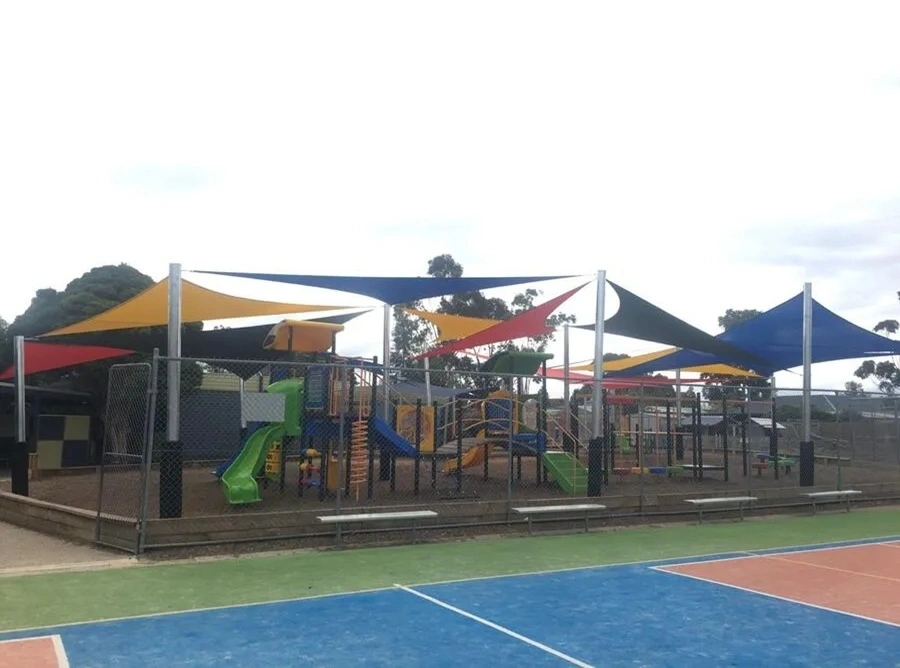
Artificial turf looks great in March. By July in Houston, it can be too hot to stand on. The lawn that was supposed to be low-maintenance has become a heat-soaked mat that the kids avoid, the dog won’t cross, and the restaurant patio staff dread setting up at 3 p.m. Hot turf is one of the most common complaints we hear from homeowners and property managers, and it has a surprisingly simple fix: shading turf areas with a properly engineered shade sail. Done well, shading turf areas turns a no-go zone into usable space.
This guide to shading turf areas explains why synthetic grass runs so much hotter than a real lawn, what the research actually says, and how shade changes the equation. We’ll cover backyards, pool decks, dog runs, patios, daycares, apartment amenities and more. You’ll also learn what shade can’t do, how to plan around the turf you already have, and what to expect on cost, permits and grant funding. If you’re deciding whether a sail is the right way to protect your turf and the people using it, you’ll know exactly what to ask by the end.
Quick Takeaways
- Artificial turf runs far hotter than natural grass. In one field study it hit about 162°F while nearby real grass stayed near 98°F. This September, turf at an NFL stadium was reported at 157°F.
- The heat comes from the sun. Turf absorbs sunlight and doesn’t cool itself by evaporation, so blocking direct sun attacks the cause.
- A shade sail is a practical way of shading turf areas over backyards, pool decks, dog runs, patios and playgrounds, and it lets air flow through.
- Shade cuts turf temperatures dramatically in controlled testing. Australian researchers measured synthetic turf peaking near 184°F in sun and about 107°F in shade, though not under an installed sail, so measure your own before and after.
- Natural lawns struggle under dense shade. If you’re keeping real grass, plan the sail around sun hours and grass type.
- Plan posts and drainage before the turf goes in (or around it if it’s already there).
- Schools, daycares and nonprofits may qualify for grant money. The AAD program offers up to $8,000, with a December 18, 2026 deadline.
Why Artificial Turf Gets So Hot (and Why Shading Turf Areas Helps)
If you’ve ever stepped onto a synthetic lawn at 2 p.m. in August, you already know the answer: very hot. But the details matter, because they explain what shade can and can’t fix.
Turf vs. Grass: What the Numbers Show
Two peer-reviewed field studies put real numbers on the problem. In Hong Kong, a researcher measured an artificial turf surface at about 162°F on a sunny summer day, while adjacent natural turf reached only about 98°F, according to a study in Landscape and Urban Planning. That’s a gap of more than 60°F between two surfaces sitting side by side.
A separate study in Amsterdam found the same pattern at lower air temperatures. During summer 2020, conventional artificial turf peaked at about 154°F, while natural grass peaked at about 116°F, as reported in Frontiers in Sustainable Cities. Houston’s climate is humid subtropical, like Hong Kong’s, so don’t assume your turf will behave like the Amsterdam numbers.
A Recent Example: The Titans-Eagles Turf
You don’t have to look at a lab to see this. On Sunday, September 20, 2026, the Philadelphia Eagles visited the Tennessee Titans in Nashville. Kickoff temperature was 95°F with a heat index of 107, yet the turf was reported at 157°F, more than 60 degrees above the air. Reports say cleats began melting; Titans safety Amani Hooker said the midsoles of his cleats “melted completely off,” and Eagles lineman Cam Jurgens went through several pairs. Cameras caught water being poured on players’ cleats, and Eagles coach Nick Sirianni said he would need an IV afterward. Axios Nashville noted it was the second straight week of extreme heat at the stadium.
The Science in Plain English
Real grass is a living cooling system. It releases water vapor, which carries heat away, and it reflects more sunlight than a synthetic mat. Artificial turf does neither. The Hong Kong study attributes the difference to lower reflectivity and little evaporation: the turf soaks up shortwave radiation, stores heat, and releases it quickly. Plastic fibers, a backing layer and (in many installations) a dark rubber infill all absorb and hold heat.
Why Houston Makes It Worse
Houston stacks the deck against turf. Summers are long, hot and humid, and Gulf humidity keeps nights warm, so turf has less time to release the heat it stored all afternoon. Heat that builds in a dry climate lingers longer here.
Why This Matters for Your Shade Plan
Here’s the part most articles skip: the Hong Kong study also found that solar input drops to about half of its sunny-day level on cloudy days and about a quarter on overcast days, and that turf heated far less under those skies. In other words, the turf’s heat tracks the sunlight hitting it. That’s the strongest argument for shading turf areas, because a sail doesn’t mask the symptom. It intercepts the cause before the sun ever reaches the fibers.
If you want to see how we think about sails in Houston’s climate more broadly, our shade sail guide for Houston homeowners covers fabric, posts and wind in depth.
What Hot Turf Means for Kids, Pets and Customers
Heat isn’t just a comfort issue. It changes who uses a space and how safely they can use it.
Burns, Barefoot Feet and Bare Paws
The practical risk is simple: very hot surfaces can burn skin. The Hong Kong study focused on heat stress for athletes and didn’t assess burn thresholds, so we won’t quote a burn temperature here. But common sense and a quick hand test tell you plenty. If you can’t comfortably rest your palm on the turf for a few seconds, a child’s bare foot or a dog’s paw shouldn’t be on it either. Our playground guidance makes the same point: hot equipment and surfaces can be hot enough to burn a child’s skin, which is why many schools and daycares keep kids indoors on summer afternoons.
UV Exposure Comes Along for the Ride
Turf heat and UV exposure arrive together, and the CDC notes that UV rays can start damaging unprotected skin in as little as 15 minutes (CDC). A sail addresses both problems at once. The Skin Cancer Foundation reminds us that not all shade is equally protective, because fabric quality, size and coverage matter, which is one reason we install commercial-grade shade fabric rather than lightweight kit cloth.
The Business Side of Hot Turf
For commercial properties, hot turf is also an amenity problem. A restaurant patio that guests can’t use at 4 p.m. loses revenue. An apartment pool deck or dog park that’s too hot stays empty, and residents notice. A daycare courtyard with scorching turf shortens outdoor time. Shading turf areas turns dead hours into usable ones.
Why Shading Turf Areas Is Different From Cooling Them
Hosing down turf offers brief relief, because evaporating water pulls heat out of the surface, but it fades in minutes and wastes water. Shade works differently: it keeps the heat from building in the first place. That’s why property managers who struggle with hot amenity lawns usually end up adding permanent shade rather than relying on sprinklers or misters alone.
A Quick Self-Check
Before you spend a dollar, try this on a sunny afternoon. Walk your turf at 3 p.m. and note which areas you avoid. Those are the zones where a sail will earn its keep. Most spaces have two or three hot spots rather than a uniformly bad lawn, and that shapes how many sails you need and where the posts should go.
How Shade Sails Work for Shading Turf Areas (and What They Don’t Do)
A shade sail is a piece of knitted fabric stretched tight between posts or anchor points. For shading turf areas, it works like a tensioned canopy that blocks direct sun while letting air move through.
Blocking the Source of the Heat
Because turf heat comes from absorbed sunlight, shading turf areas directly reduces the energy the surface receives. Our sails use Gale Pacific Commercial 95 fabric, which is built to block the large majority of UV and, as a knitted mesh, lets hot air escape rather than trapping it under a solid roof. The sails we design for turf areas are sized to cover the hours you use the space, not just the center of the lawn.
What the Research Says About Shade Over Turf
The best direct evidence we found is a 2022 experiment at Western Sydney University, published in Building and Environment. Researchers set out samples of synthetic turf, rubber tiles and natural lawn, measured their maximum surface temperatures in full sun on one day, and measured them again under a shade structure on a similar day. The shade blocked 97% of light and all UV.
The results for turf were striking:
- Long-blade synthetic turf: about 184°F in sun, about 107°F in shade.
- Medium-blade synthetic turf: about 176°F in sun, about 108°F in shade.
- Short-blade synthetic turf: about 166°F in sun, about 109°F in shade.
- Natural lawn: about 131°F in sun, about 93°F in shade.
The authors reported that shaded surfaces never reached burn-threshold temperatures. Notice that turf dropped by roughly 57 to 77 degrees, more than the natural lawn did.
Sizing and Placing a Sail for Turf
Fabric is only half the story. A sail that is too small, or hung in the wrong spot, leaves the turf in sun for part of the day and gives up much of the benefit. When shading turf areas, we start with the hours the space is used, map where the sun falls during those hours, and size the sail to cover that path instead of just the center of the lawn. Larger or irregular spaces often work better with two or three overlapping sails than with one oversized sail, because overlapping shapes cover more of the sun’s path, shed rain better and keep individual post loads reasonable. Sail height matters too: a higher sail lets more breeze pass underneath and blocks the low afternoon sun less, so we balance both when we set post heights during the site visit.
Shading Turf Areas at Home: Backyards, Pools and Pets
For homeowners, shading turf areas usually means one of four places: the backyard play area, the pool deck, the dog run and the patio. Each one calls for a slightly different sail layout.
Backyard Play Areas and Lawns
Kids will use turf for hours when it’s comfortable and abandon it entirely when it’s not. A sail placed to cover the afternoon sun path (the west and southwest side in Houston) turns a lawn that sits empty from May through September into a daily-use space. Most backyard sails run $4,000 to $8,000 per sail installed, and larger lawns often use two or three overlapping sails to cover odd shapes and shed rain. See our residential shade sails page for how those layouts typically work.
Pool Decks With Turf
Plenty of Houston pool decks now include a strip of turf for lounging or play, and it’s one of the hottest spots in the yard because it sits next to reflective water and concrete. A sail over the pool deck does double duty: it protects the turf and keeps the pool water from heating up as quickly, which helps with pool comfort as well. Our pool shade sails page covers pool-specific layouts, and the same layered approach works well when turf sits alongside the water.
Dog Runs and Pet Areas
Pet turf is a special case because dogs have little say in where they walk. A shaded run gives a dog a cooler surface and a place to lie down in the afternoon, which is often when owners are away at work. Place the sail so shade falls on the area your dog actually uses, not just the center of the yard. When shading turf areas for pets, a good rule of thumb is that the sail should cover the turf and a margin around it, because the sun angle shifts through the day.
Don’t Forget the Edges
Shading turf areas well means planning for the sun’s movement. A sail that perfectly covers the turf at noon may leave one end exposed by late afternoon. That’s why we measure on site, check sun angles, and design the shape around your actual use hours instead of dropping a standard rectangle over the lawn.
A Perspective Most Guides Skip
Many homeowners install turf to save on water and mowing, then discover the heat cost. Shading turf areas doesn’t undo that choice, it completes it. A turf yard with a well-placed sail is often more usable in July than a natural lawn baking in direct sun, because the grass can’t protect your feet any better than the fabric can protect your afternoon.
Shading Turf Areas for Businesses, Schools and HOAs
Commercial turf has the same physics, but the stakes include liability, revenue and resident satisfaction.
Restaurants, Patios and Apartment Amenities
Turf patios and amenity lawns are popular with restaurants, bars and apartment communities because they look good and don’t need mowing. They also get very hot. Shading turf areas lets a patio be usable from roughly May through September, and sails let breeze through, so spaces stay cooler than under a solid roof. For apartment complexes and HOAs, shade over pool decks, amenity areas and dog parks is a popular and relatively inexpensive upgrade, as our commercial shade sails page explains.
Daycares, Schools and Playground Turf
Playground turf is where heat and safety collide. Hot slides, decks and turf can burn small children, and that pushes recess indoors. Shade keeps equipment and ground surfaces cooler, protects kids from UV, and gives teachers back their afternoons. For schools, shading turf areas also protects play equipment, and we design school and daycare layouts to keep posts out of fall zones and play paths, keep sightlines clear for supervision, and match school colors where requested. You can read more on our playground shade sails page.
Funding Shade for Schools and Daycares
Schools, daycares and nonprofits have a funding option homeowners don’t. The American Academy of Dermatology runs a Shade Structure Program that awards up to $8,000 toward a structure and its installation. The 2026 application window runs from October 19 to December 18, applicants need a sun-safety program and a dermatologist’s support letter, and the structure must be installed after the award rather than before. We’ve broken down the requirements, fabric UV figures and application tips on our Texas shade grants page, though we don’t write grants or guarantee awards.
Sports Facilities and Large Turf Fields
Athletic turf can be a much larger project, and the engineering moves from sails to shade structures with framed steel and a fabric canopy. These cover bleachers, sidelines and seating areas rather than the whole field. If you’re a facility manager or booster club weighing options, we’ll recommend a sail, a structure, or a mix after a site visit.
What Property Managers Should Ask For
For commercial work, ask for a written proposal that covers layout, colors and total price, a certificate of insurance before work begins, and installation scheduled around your operating hours. Our commercial installs can also include engineered drawings and wind-load calculations when a city, HOA or property manager requires them.
What About Natural Grass Under a Shade Sail?
Not everyone with turf has artificial turf. Plenty of Houston lawns are real grass, and the question we hear is whether a sail will kill it.
Shade Stress in Real Lawns
It can thin it. Shade reduces photosynthesis and increases competition for water and nutrients, according to K-State turfgrass guidance. The same source says even the most shade-tolerant grasses generally need at least four hours of direct sun, and that very dense shade (below about 15 percent light transmission) may be too dark for turf to survive. It also notes that bermudagrass tolerates shade poorly, while zoysiagrass handles it better. The article doesn’t address St. Augustine, the most common Houston lawn grass, so ask a local turf professional about your specific variety.
Sail Fabric and Light
A sail over a lawn behaves like a canopy, not a tree. A knitted fabric that blocks a large share of UV also blocks a large share of the light grass needs. That’s a feature on a patio and a problem on a lawn you want to keep green.
How to Shade Part of a Lawn Without Losing It
If you’re shading turf areas that are real grass, plan the sail around the hours the space is used rather than covering the whole yard. Place the sail over the hot, high-traffic zone (a seating or play area) and leave the rest of the lawn in direct sun. Raise the mowing height under the sail, and ease off fertilizer in shaded zones, as the K-State guide recommends. If you want the lawn to thrive as well, you may decide a section of turf under the sail and natural grass elsewhere makes more sense.
Matching Grass Type to Shade Level
Different grasses respond differently. K-State’s guidance ranks shade tolerance by species, and the practical takeaway is that a sail covering a lawn for most of the day calls for a shade-tolerant variety or a partial layout. Before shading turf areas that are real grass, check the variety with a local turf professional and decide whether you want the sail over the whole lawn or just the seating and play zone.
When Turf Is the Smarter Choice Under Shade
Some homeowners end up swapping grass under a sail for synthetic turf, which doesn’t need sunlight to look good. If you go that route, plan the posts and footings first, as we’ll cover next.
Planning Your Sail: Placement, Posts, Drainage and Permits
Successfully shading turf areas is mostly planning. Get the layout right and the install is straightforward.
Choose Where the Shade Needs to Fall
The first step in shading turf areas is mapping the sun. Walk the space at the hours you use it. Mark where the sun lands at 11 a.m., 3 p.m. and 5 p.m. A sail over turf should extend past the edge of the area you want shaded, because the shadow moves. Our designers check sun angles on site and work backward from your use hours, which is why we visit before quoting.
Posts, Footings and Existing Turf
Posts are the biggest cost driver in shading turf areas, and they matter more near turf. Our posts are square steel with a quarter-inch wall (4×4 for sails up to 23 feet, 6×6 for larger), standing 10 to 12 feet above grade and set 5 to 6 feet deep in concrete footings. If you’re installing turf and a sail together, set the footings before the turf goes down. If the turf is already there, ask your installer how they’ll cut and patch around each post. The same applies to buried utilities, irrigation lines and pool equipment, which we check during the site visit. Our shade sail cost guide explains how posts affect price.
Drainage and Rain
When shading turf areas, remember that a sail sheds some rain and lets the rest through, and shaped sails slope so water runs off. Ask where the low corner will drain. You don’t want it dumping onto the edge of your turf base or into a low spot that already stays wet.
Permits and Approvals
Rules vary by city, size and use. Our commercial team notes that in the City of Houston, tensioned fabric structures standing 180 days or more fall under membrane-structure rules that require wind-load design, and other cities have their own requirements. Commercial properties may need sign-off from a property manager, HOA board or city, and residential HOAs often have the final say. We’ll tell you what we expect to apply during the site visit.
Warranty and Timeline
Most projects take about four weeks from first call to finished install. We back the shade fabric with a 15-year warranty and the steel posts with a one-year warranty. For the full process, see our process page.
Cost, Timing and Next Steps for Shading Turf Areas
Here’s what to expect when you decide to move forward.
What Shading Turf Areas Costs
Shading turf areas with a residential sail around Houston typically costs $4,000 to $8,000 per sail, fully installed. Where you land depends on the size of the sail, how many posts it needs, post height and site conditions. Commercial and playground projects vary more widely, since larger properties may need several sails, taller posts or engineered drawings, so we quote each one after a site visit, based on the size of the space, the number of sails and the number of anchor points.
What Drives the Price
Four things move the number most: sail size, post count, post height and site conditions such as existing turf, irrigation lines or tight access. Adding a second sail to cover an L-shaped yard costs more than one larger sail, but it can shade the right zones without overbuilding. Commercial projects add engineering, insurance paperwork and scheduling around business hours. We explain each line item in the written quote so you can compare it with any other bid.
Is It Worth It?
Compare the cost of shading turf areas with the value of space you can’t use today. A turf yard, pool deck or patio that sits empty from May through September is a place you pay for and don’t enjoy. Spread a sail’s price across a 15-year fabric warranty and the monthly cost is modest compared with what the space gives back, whether that’s family time at home or a patio full of paying customers.
How to Get Started
If you manage a larger property, bring your site plan to the consultation so we can map every area that needs shade, sequence the work around your schedule, and give you a single written proposal. To start shading turf areas, book a free consultation, and we’ll visit, measure, check sun angles and anchor points, and give you a written quote with the layout, fabric color and total price. Call (713) 489-5141 or use our contact page. If you’re a school or daycare, ask about the AAD grant timeline early, because applications must be filed before installation.
Where We Work
We serve Houston, Katy, Sugar Land, Cypress, The Woodlands, Pearland and the surrounding area. See our service areas for the full list.
Ready to Start Shading Turf Areas?
Hot turf is a solvable problem, and shading turf areas is the most direct fix. The research tells us why synthetic grass runs so much hotter than natural lawn, and the answer points straight at the sun. A shade sail intercepts that sunlight before it reaches the fibers, protects the people and pets using the space, and lets air move through instead of trapping it.
The key is doing it right: sizing the sail around the hours you actually use the space, setting posts and footings before or around your turf, planning drainage, and getting approvals in order. Measure your own surface temperatures before and after so you have real numbers instead of promises. If you’re keeping natural grass, plan the sail so the lawn still gets the sun it needs. And if you run a school, daycare or nonprofit, look at the AAD grant early, because the application window closes December 18, 2026.
We’re a Houston shade sail installer, and we’ll tell you honestly whether a sail is the right fit for your turf and your budget. Book your free, no-pressure consultation at pathstoneco.com/contact or call (713) 489-5141, and let’s make your turf somewhere people actually want to be.
Frequently Asked Questions About Shading Turf Areas
How hot does artificial turf get in the sun?
It can get much hotter than natural grass. One Hong Kong field study measured artificial turf at about 162°F while nearby natural turf was about 98°F. Actual temperatures in Houston depend on turf color, infill, sun angle and air temperature.
Will shading turf areas with a sail cool down artificial turf?
Yes, in controlled testing. A 2022 Western Sydney University experiment found synthetic turf peaking around 166°F to 184°F in sun and about 107°F to 109°F in shade. That test used a temporary shade structure rather than an installed sail, so we recommend measuring your own before and after with an infrared thermometer.
Can you put a shade sail over artificial turf?
Yes. The key is coordinating posts and footings with the turf. If the turf isn’t installed yet, set the footings first. If it’s already down, your installer should cut and patch around each post.
Is a shade sail good for dog runs and pet turf?
A shaded run gives dogs a cooler surface and a place to rest, especially in the afternoon. Place the sail so shade covers the area your dog actually uses, and check the surface with your palm before letting pets onto turf in full sun.
Will a shade sail kill my natural lawn?
It can thin it if the sail blocks too much light. University guidance says even shade-tolerant grasses need roughly four hours of direct sun, so plan the sail over the high-use area and leave the rest of the lawn in sunlight.
How much does shading turf areas cost in Houston?
Most residential sails used for shading turf areas cost $4,000 to $8,000 per sail, fully installed. Commercial, school and playground projects are quoted per site after a visit.
Can schools and daycares get funding for turf and playground shade?
Possibly. The American Academy of Dermatology offers grants of up to $8,000 for shade structures at eligible schools, daycares and nonprofits, with a December 18, 2026 deadline this cycle. See our Texas shade grants page for requirements.
Do I need a permit for shading turf areas in Houston?
Often, yes, though it depends on your city and the structure. In the City of Houston, tensioned fabric structures standing 180 days or more fall under membrane-structure rules that require wind-load design. We’ll tell you what we expect during the site visit.
What’s the best way to keep artificial turf cooler besides shade?
Combine shade with lighter turf colors, light-colored infill, proper drainage and an occasional rinse. Shade addresses the cause, and those steps help with the rest.
References
External sources
- ESPN, Yahoo Sports and Axios Nashville (September 2026) coverage of the Eagles-Titans game: ESPN · Yahoo Sports · Axios Nashville
- Jim, C.Y. (2017). Intense summer heat fluxes in artificial turf harm people and environment. Landscape and Urban Planning, 157, 561-576. sciencedirect.com
- Pfautsch, S., Wujeska-Klause, A., and Walters, J. (2022). Outdoor playgrounds and climate change: Importance of surface materials and shade to extend play time and prevent burn injuries. Building and Environment, 223, 109500. sciencedirect.com
- van Huijgevoort, M.H.J., Cirkel, D.G., and Voeten, J.G.W.F. (2024). Climate adaptive solution for artificial turf in cities: integrated rainwater storage and evaporative cooling. Frontiers in Sustainable Cities, 6. frontiersin.org
- Kansas State University. Turfgrass and Shade Stress, Part 2: Turfgrass Management in Shaded Areas. k-state.edu
- Centers for Disease Control and Prevention. Sun safety recommendations (CDC Stacks). stacks.cdc.gov
- Skin Cancer Foundation. Healthy Skin: Made in the Shade? skincancer.org
- American Academy of Dermatology. Shade Structure Program. aad.org
Pathstone Co pages (internal)